
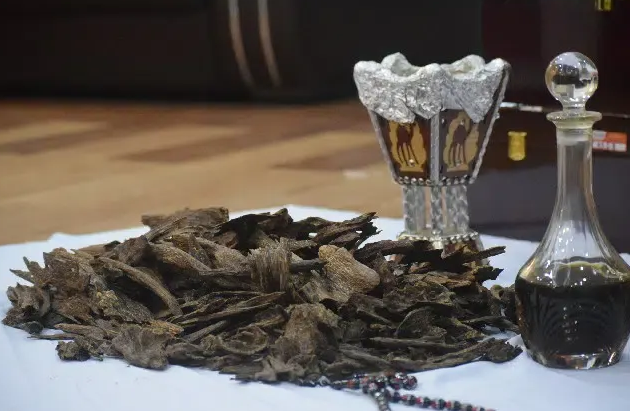
Agarwood incense (commonly known as oud incense or bakhoor) is a fragrant mixture produced by grinding various types of oud and agarwood together, resulting in a distinct aromatic scent. It has been utilized as an important custom across homes and public or religious occasions from ancient times to the present day.
There are various mixtures prepared from oud incense across different regions of the world, each with a unique profile named after its place of origin. Burning oud incense is a longstanding tradition, particularly famous in the Arabian Gulf and other regions, where homes are fumigated for its unique smell.
Overview of Agarwood and Incense Trade
-
Extraction and Sourcing: Agarwood material is extracted from oud trees located in Asian countries with abundant forests, including Malaysia, Indonesia, Thailand, Cambodia, India, the Philippines, and Laos.
-
Economic Importance: The oud trade has served as a vital pillar of the state's economy historically and into modern times.
-
Pricing Factors: The quality, features, market availability, and country of origin determine the variations and prices of incense sticks.
-
Cultural Hospitality: In Gulf countries, it is a widespread custom to place incense and oud on charcoal in a bakhoor burner and pass the censer over guests individually to indicate good hospitality.
The Finest Types of Natural Oud Incense
-
1. Cambodian Agarwood Incense: Widely regarded as one of the most luxurious and expensive types of oud bakhoor. It is heavily saturated with oud oil, features a very dark color, and is exceptionally rare. Variants include luxurious Cambodian oud, super triple, and royal oud.
-
2. Sioufi Agarwood Incense: A Sioufi incense with a stable, refreshing scent (Zakia) that spreads widely and lasts for long periods at a reasonable price. It is frequently used during public events, religious occasions, Ramadan, and Fridays.
-
3. Indian Agarwood Incense: Considered a rare and distinctive incense with a light brown color, heavy weight, and a long-lasting smell. Due to strict export restrictions by the Indian government to protect forests from desertification, it holds high value.
-
4. Moruki Agarwood Incense: Extracted from eastern Indonesia, Moruki incense features a calm, beautiful aroma with a dark or light brown color that spreads everywhere upon fumigation.
-
5. Sandalwood Agarwood Incense: Extracted from sandalwood trees in Asian countries like India, it is a sweet, budget-friendly option used in homes, public events, and therapeutic applications.
-
6. Clementan Agarwood Incense: A sweet and attractive type brought from Clementan, Indonesia, heavily favored by customers across the Arab Gulf countries for special occasions.
-
7. Laosy Agarwood Incense: Listed among the most expensive incense sticks in the world due to its extreme scarcity, making it an exclusive choice typically acquired by the wealthy and princes.
-
8. Malaysian Agarwood Incense: Characterized by an appropriate price and market abundance, varying in quality, color, and scent according to its extraction forests.
-
9. Vietnamese Agarwood Incense: Mostly cultivated, rare, and features a calm smell, good market price, and strong stability on home furniture.
-
10. Burmese Agarwood Incense: Features scents similar to Indian oud, offering a pleasant, cooler scent on the nose compared to spicy oud scents, though priced slightly higher.
-
11. Jawi Agarwood Incense: Extracted from the vast forests of Java, Indonesia, Jawi incense is a low-priced option that provides a stable and splendid scent during evaporation.